Simpler, Yet Harder…

I took a CPR/AED class last night to refresh my training since my certificate expires in February.  The new rules are interesting, in that they’ve made things a little simpler by making the compression/breaths/repeats cycle the same for children and adults.  They also increased the number of compressions that are given so that it’s now 30 compressions followed by two breaths and the whole cycle is repeated 5 times.

However, the new rules result in CPR being more tiring.  I suspect that someone who doesn’t do CPR a lot (i.e. the majority of us) would be pretty tired if he or she had to do CPR for more than two or three minutes.

Also of interest is the change in AED guidelines.  Previously, AED’s would analyze the heart rhythm and then advise whether to shock or not.  After the shock it would reanalyze and advise to give another shock or not.  The rules no longer call for these “stacked shocks.”  Now you’re supposed to give one shock if advised and then evaluate the patient and continue CPR for another cycle (30/2×5) and then analyze with the AED again.  The older AED’s that are out there don’t do this, so you just have to know it.  Newer AED’s have the newer programming and will guide you correctly.

I’m told that all of the ones in Keller city buildings will eventually be reprogrammed with the new rules as soon as Medtronics sends the software and cable for the Lifepak 500 models that we have.

Slowly Sinking The Statist Ship

I haven’t taken the time to read the actual text of the bill, but this announcement marks an interesting turnaround in disaster-related firearms policy.

Fairfax, VA- The National Rifle Association (NRA) and law-abiding gun owners scored a significant victory yesterday when the United States Congress acted to prohibit the confiscation of legal firearms from law-abiding citizens during states of emergency, barring practices conducted by officials in New Orleans in the wake of Hurricane Katrina. This action was included in the Department of Homeland Security Appropriations bill that passed both chambers of Congress. This bill now heads to President Bush for his expected signature.

I remember some years ago that CDC was pushing a rather odious idea known as the Model State Emergency Health Powers Act (which later came under the “Turning Point National Collaborative on Public Health Statute Modernization”).  The model legislation had been around for a while, and 9/11 gave them the excuse to push it under the guise of homeland security.  Here’s a brief summary of the key points of the act (emphasis added):

Under the Model State Emergency Health Powers Act, upon the declaration of a “public health emergency,” governors and public health officials would be empowered to:

  1. Force individuals suspected of harboring an “infectious disease” to undergo medical examinations.
  2. Track and share an individual’s personal health information, including genetic information.
  3. Force persons to be vaccinated, treated, or quarantined for infectious diseases.
  4. Mandate that all health care providers report all cases of persons who harbor any illness or health condition that may be caused by an epidemic or an infectious agent and might pose a “substantial risk” to a “significant number of people or cause a long-term disability.” (Note: Neither “substantial risk” nor “significant number” are defined in the draft.)
  5. Force pharmacists to report any unusual or any increased prescription rates that may be caused by epidemic diseases.
  6. Preempt existing state laws, rules and regulations, including those relating to privacy, medical licensure, and—this is key—property rights.
  7. Control public and private property during a public health emergency, including pharmaceutical manufacturing plants, nursing homes, other health care facilities, and communications devices.
  8. Mobilize all or any part of the “organized militia into service to the state to help enforce the state’s orders.”
  9. Ration firearms, explosives, food, fuel and alcoholic beverages, among other commodities.
  10. Impose fines and penalties to enforce their orders

Sometimes I really worry about “health professionals.”  So often when you scratch the surface of one you run into an unalloyed statist, and this proposal is just more of the same (it’s interesting to note that one of the key players in this nonsense was also deeply involved in the Hillarycare debacle). 

I can only hope that this new legislation overrides or invalidates any confiscation-related firearm provisions that might have been adopted in various states:

As of July 15, 2006, thirty-two (32) states have introduced a total of one-hundred and three (103) legislative bills or resolutions that are based upon or feature provisions related to the Articles or sections of the Turning Point Act. Of these bills, thirty-nine (39) have passed.

A lot of the provisions that have passed were related to reporting of diseases, so you’d have to check state-by-state for emergency firearms laws.  But that this passed is a positive step in the direction of invalidating odious laws.

Update.  The new law forbids the Federal government, or anyone working for or on behalf of (takes Federal funds), from confiscating firearms, etc.

‘‘SEC. 706. FIREARMS POLICIES.
‘‘(a) PROHIBITION ON CONFISCATION OF FIREARMS.—
No officer or employee of the United States (including any member of the uniformed services), or person operating pursuant to or under color of Federal law, or receiving Federal funds, or under control of any Federal official, or providing services to such an officer, employee, or other person, while acting in support of relief from a major disaster or emergency, may—
‘‘(1) temporarily or permanently seize, or authorize seizure of, any firearm the possession of which is not prohibited under Federal, State, or local law, other than for forfeiture in compliance with Federal law or as evidence in a criminal investigation;
‘‘(2) require registration of any firearm for which registration is not required by Federal, State, or local law;
‘‘(3) prohibit possession of any firearm, or promulgate any rule, regulation, or order prohibiting possession of any firearm, in any place or by any person where such possession is not otherwise prohibited by Federal, State, or local law; or
‘‘(4) prohibit the carrying of firearms by any person otherwise authorized to carry firearms under Federal, State, or local law, solely because such person is operating under the direction, control, or supervision of a Federal agency in support of relief from the major disaster or emergency.
‘‘(b) LIMITATION.—Nothing in this section shall be construed to prohibit any person in subsection (a) from requiring the temporary surrender of a firearm as a condition for entry into any mode of transportation used for rescue or evacuation during a major disaster or emergency, provided that such temporarily surrendered firearm is returned at the completion of such rescue or evacuation.”

The repeated references to “Federal, State, or local law” have me wondering, though.  Reading (3), it would appear that if a state passed a law in advance that gave the police power to confiscate firearms in an emergency, that it might just fall under the “not otherwise prohibited by Federal, State, or local law” phrasing.  I suppose the proof will be in whether we see anyone actually win a suit based on this law and the size of the verdict (it’s somewhat telling that no criminal liability appears to be attached to violation of the new statute).

Thanks, Big Gov!

I’ve recently been experimenting with VoIP through AT&T’s CallVantage service for my business line (at the request of my company, as CV would save money over my current Verizon setup, which they are reimbursing).  Unfortunately, thanks to the FCC, there are some very obnoxious features included with the service.

The big problem is that the FCC has MANDATED that all “interconnected VoIP providers” also provide 911 services:

All interconnected VoIP providers must automatically provide 911 services to all consumers as a standard, mandatory feature without consumers having to specifically request this service. VoIP providers may not allow their consumers to “opt-out” of 911 service.

An “interconnected” provider is one that “allows you to make and receive calls to and from traditional phone numbers.” 

First, AT&T won’t even consider providing you VoIP service unless you live in an area where they can access the 911 center to send information.  In those areas where they can provide 911 service, they’ve implemented a set of obnoxious and bothersome rules for making sure you haven’t moved the Telephone Adapter (TA).  Every time the TA is powered off or loses Internet connectivity, you are REQUIRED to reconfirm your address with them.  This is to guarantee that you haven’t picked up the TA and taken it with you on a trip or something.  The problem is that you pick up the phone expecting to make a call, dial a number, and then instead of getting connected your call is rerouted to a voice prompt where you have to confirm the address.  Only after doing this is your call completed.  And if you happen to access the CallVantage website, the first thing it does is prompt you there (in big ugly RED letters).

<Update>
It occurs to me that this prompt isn’t very useful, since if you’re in a hurry to make a call (i.e. join a conference call) you’re likely just to press “1” regardless of where you are.  And it’s especially annoying in that you have to listen to the entire spiel before you can press a key, unlike nearly every other VRU in the world where you can enter the digit as soon as it starts talking.  There’s no incentive to give the correct address, especially if changing the location/address will take you even longer.
</Update>

Unfortunately, the dingbats at the FCC, in making this “mandatory” and not allowing “opt-out” have made it so that I get bothered if there’s a momentary power or Internet interruption.  Since I have a “regular” line there’s no need for me to use the VoIP line for 911.  In any situation where my regular phone line is out, my Internet service would also likely be out, since they’re both provided across the same fiber link.

There ought to be a way for people who have a regular landline available to them to opt out of this nonsense.  But the FCC, in protecting me from myself, has decided that its one-size-fits-all solution is best and that it knows better than I do what’s best for me.

A Lost ART(s)?

While I’m rambling on about ham radios, I suppose I ought to mention a feature of the Yaesu radios that I was curious about called ARTS, which stands for Automatic Range Transponder System.

This feature is found on a number of their handhelds as well as several of their mobile/base units.  You set both radios to the same simplex frequency and DCS code, then activate the ARTS feature.  The radios will transmit for about 1 second every 25 seconds and will listen the rest of the time for a signal with the same DCS code.  When a signal with the right DCS code is received, the radio announces that it’s “in range” (with a beep and text on the display).  After one minute with no received signal, the radio will announce that it’s “out of range.”  Radios with ARTS also have a feature that will store your callsign and send it every 10 minutes via CW (“DE [your callsign] K”) to satisfy FCC identification requirements.

Just out of curiosity I tried it between the FT-60R and the VX-7R, but I didn’t really see much utility for the feature.  First, everyone using it would be required to have a Yaesu radio.  Second, it seems like an awful lot of transmission activity, which might wear down your battery.  It’s also a one-to-one relationship, so a base unit operator would have no way of handling multiple HT’s in the field (which is one of the few uses I could see for the feature, as it would allow the base operator to use his more powerful radio to call the HT with a message to move in closer to maintain communications).

I did several different searches on Google using combinations of “Yaesu” and “ARTS” (i.e. “A.R.T.S.” and spelling out the words) to see if anyone was using it or had an opinion, but the only hits I got were either from Yaesu marketing materials (including listings with several online stores) or from radio reviews.  No one that I could find seems to be using it (or if they are, they aren’t saying anything about it online).

Yaesu FT-60R vs Yaesu VX-7R

I’ve had a Yaesu FT-60R HT for about a year and a half now.  While I did quite a bit of research before buying it, actually using it showed me where my research method was faulty.  The radio itself is good, in that it does what it says it will and I’ve had no technical issues with it.  It even survived a very heavy rain at the beginning of this month.  The problem is that it’s damn complicated to operate.  When I did the research I downloaded the manual and read a good portion of it, but the complication didn’t really show itself until I actually tried to use it.

The primary complication is that most of the keys perform three functions.  The first function is on the key’s face and the second is marked above the key.  The problem arises in the third function, which is not marked anywhere on the radio’s face.  Consider the “1” key.  Pressing “1” in VFO mode enters the digit.  Pressing FW+1 enters “squelch type” selection mode (i.e. choose CTCSS, DCS, or none), and the text “SQ TYP” marked above the key at least helps you to remember the function.  However, pressing and holding the 1 key activates weather band receive mode.  There is no marking on the radio to indicate this.  You have to read the manual and memorize this fact if you ever want to listen to the weather band. 

Another member of our CERT just bought a Yaesu VX-7R to replace his previous radio which died after being exposed to a heavy rain.  I played with it for a little while last Thursday night and was immediately struck by how much easier it is to use than my FT-60R.  The “triple overload” (i.e. press-and-hold) options on the FT-60R have generally been moved to menus on the VX-7R and the use of press-and-hold is much more limited (i.e. pressing and holding the digit keys now results in the radio’s operating state being stored in the corresponding “hyper” memory location).

Most features and modes of the VX-7R can be accessed through the menus or shortcuts to submenus that are marked above the keys.  For example, to enter menu mode, you press MonF and then 0, which has “SET” marked above it.  Activating weather band receive mode is MonF+3 (3 has “WX” marked above it).  This is far more intuitive that trying to remember that you have to press and hold “1” to get to the weather band.  Setting the CTCSS mode and tones is done via MonF+8/TONE, which activates the submenu that is specific to tone encoding and squelch.

To get an idea of the difference in operation, consider trying to access a repeater at 146.94 that uses CTCSS encoding to activate the repeater (but which doesn’t send it on the repeater output) with a tone of 110.9.  Both assume you’re in VFO mode to start (i.e. this isn’t already programmed in).

FT-60R:

  • Enter repeater frequency (the radio will know it’s a repeater frequency and automatically determine the direction and offset, unless ARS has been disabled).
  • Press FW, then press 1/SQ TYP.
  • Rotate the selector knob until “TONE” is displayed.
  • Press PTT to select.
  • Press FW, then press 2/CODE.
  • Rotate the selector knob until 110.9Hz appears.
  • Press FW again to activate the tone (note inconsistent activation behavior between SQ TYP and TONE selection menus).

VX-7R:

  • Enter repeater frequency (ARS, which is the default, will automatically set direction and offset).
  • Press MonF+8/TONE to activate TSQ submenu.
  • In menu item #1 (SQL TYPE), press MAIN/SUB until TONE appears.
  • Rotate selection dial one step to get to menu item #2 (TONE SET).
  • Press BAND key to activate value selection mode.
  • Press MAIN/SUB until 110.9 appears.
  • Press BAND to deactivate value selection mode.
  • Press PTT to save and activate the settings.

The selection behavior is more consistent with the VX-7R in that MAIN/SUB are used as up/down buttons and BAND is used to activate entry/selection mode for certain submenus that have numeric or text settings (as opposed to those with discrete settings, like the SQL TYPE submenu above).

Another area where the VX-7R is superior is the size and resolution of the display.  The FT-60R uses a segmented-style LCD with backlight, while the VX-7R uses a matrix-style LCD with backlight.  The VX-7R can display icons as well as variable sized text.  This allows for more expressive menu items, which makes them easier to understand.  For example, when setting the lock mode on the FT-60R, you have to first select the LOCK menu item, then selecting “LK K+D” on the next screen means that the lock function locks out the keypad and the dial.  On the VX-7R, the menu shows the full text “KEY+DIAL,” and fits everything onto one screen.

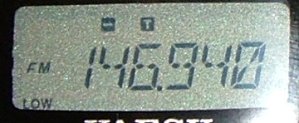
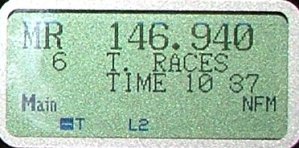
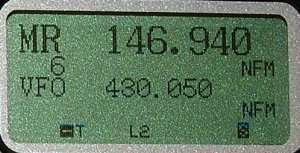
Here are a few screen shots for comparison.  Sorry about the glare and fingerprints.  It’s harder than it looks to get good pictures of shiny, curved, clear plastic items.

FT-60R in VFO mode:

VX-7R in memory mode with dual receive turned off (same repeater and settings, though):

VX-7R in dual receive mode:

So now I’m the owner of both an FT-60R and a VX-7R.  I suppose that if I’d known at the time I bought the FT-60R what I now know about the VX-7R I would have probably bought the 7R.  However, in favor of the FT-60R, it was about $200 less and the VX-7R had features I never thought I’d use or need (like 6m operation and submersibility).  The price difference has changed since then, though, and the VX-7R is now only about $120 more than the FT-60R.

While I’m at it, I’d like to note the quick service of Austin Amateur Radio.  I ordered the VX-7R last Friday morning, received a ship notification on Friday evening, and received the radio Monday afternoon.

Passing On…

I see this morning that Col Jeff Cooper has died.

World-renowned firearms expert Jeff Cooper, founder of the Gunsite firearms training center in Paulden, died Monday afternoon at his home near the training center.

Cooper, 86, had been battling several health problems in recent years.

The family plans a private burial ceremony and will announce a memorial ceremony at the National Rifle Association Whittington Center in New Mexico in the near future.

Cooper had been a member of the NRA Board of Directors.

Born on May 20, 1920, in Los Angeles, as John Dean Cooper, Cooper who always went by “Jeff,” earned a master’s degree in history and taught history.

He served in the U.S. Marine Corps during World War II as well as in Southeast Asia and Korea.

In the 1960s, he organized a group called the Bear Valley Gunslingers and the Southwest Combat League. During the organizations’ shooting competitions at Big Bear, he formulated the Modern Technique of combat handgun shooting which incorporates a large-caliber semi-automatic pistol, a two handed Weaver stance, breath control and a surprise trigger break.

In 1976, he founded the American Pistol Institute, or Gunsite, at Paulden to teach those pistol techniques and later added a full curriculum on pistols, rifles and shotguns.

Since then, more than 18,000 students, including celebrities like Tom Selleck, law enforcement officers, military members from many nations and many civilians have graduated from courses there.

He was quite possibly one of the most, if not the most, influential gun writers and instructors of the modern era.  His writings on mindset influenced hundreds of other instructors and may be more important than any of his tactical or technical methods (although those must not be discounted).

Save Your Ammo For A Real Battle

I’m probably one of the more irreligious people you’ll find, yet I can’t find the energy to get worked up over Gideons Bibles being available at Rockwall High.

Students say it would be one thing if a private religious school allowed Bibles to be passed out. But for it to happen at a public school raises constitutional questions.

When FOX 4 arrived at Rockwall High, school was just letting out, and the folks with the Gideons Bible company were just packing up. The company estimates it handed out roughly 2,000 Bibles, which is practically the entire student body.

“I couldn’t believe it,” said student Darren Childs. “I walked into school and there, right on top of a table with our school colors, are Bibles and they’re being passed out.”

From what I saw on the TV this morning, they’re simply available on a table in an area where groups commonly put out literature.  No one was passing them out in class and no one was forced to take one.  It seems to me that as long as Rockwall ISD’s policy for the use of this area is content-neutral, there’s no harm in it.  But to hear the tone of that last student you’d think they were passing out porn or something.

Heck, I remember getting these things issued to us in class (remember the little red bibles?) when I was in school.  I actually kind of liked it, as I like free stuff (except for all the free fungus in the air right now).  I also recall some groups handing out English translations of the Koran when I was in college (at a state school).  That didn’t bother me, either (except for the fact that the damn thing was so obtusely written as to be unreadable).

Now if you want to talk violations, we can mention the fifth grade teacher I had who decided BoR and SCOTUS-be-damned that we were going to have a prayer every day… 

Well There’s Your Problem!

From the ‘fungus among us’ department…

Weird Stumble…

I was following the comments in a Slashdot discussion about good and bad rack cabling which led me to a link to a particularly bad example on WayStupid.com:


WayStupid link

On the bottom of the page they have links to “random stupids.”  I clicked one which had just some police lights showing and stumbled across this:


WayStupid link

What caught my eye was that the caption said, “New Keller, TX Police Vehicles” and below the picture it said, “The Chevrolet Tahoes just weren’t holding up.”  At first I thought maybe the site was using some kind of advertising cookie or geo-IP tracking to figure out my location and customize the page, but I SSH’d into a system in California and used curl to fetch the page and it still said Keller, TX.  So the page content is definitely correct and intended to be for Keller, TX.

It just seems strange that without even trying that I’d stumble across something that referenced Keller on a site I’d never heard of until today.

(On a random tangent… check out this example of the incorrect method to use when stopping your vehicle from 178mph.)

The Theater Decorum War

That last post reminded me of something that comes up from time to time when the issue of cell phones in theaters is discussed.  Talk frequently turns to jamming or blocking cell signals to prevent the problem.  In the United States, at least, jamming is illegal.  But I don’t think some variation of Faraday Cage technology (such as the “magnetic wood” mentioned in my jamming link) would be an issue.  It seems to me that a property owner has the right to create an RF quiet zone.

But any talk of blocking always brings up someone complaining about how they have some critical need to get cell or pager signals 24×7.  They claim they’d sue the theater owner if they missed a page (the usual case is of a doctor who misses a critical page).  But I’m curious as to how they handle the fact that some buildings are already natural Faraday cages in that if the building has enough structural steel or rebar it can block signals.  It seems to me that as long as the theater makes its blocking technology conspiciously known that these people wouldn’t have any reason to complain.  If the market really demands a theater where people can take pages and phonecalls, then someone will provide one.  So instead of going to the nice, quiet, relaxing theater that I’m going to be at, they can go on down to the rude-and-noisy cineplex down the block. 

I was reminded of this by the discussion thread associated with the article on the Star-Telegram’s website, and this comment in particular:

I agree that a pleasant movie-going experience is important, especially with the prices of admission these days. I also take comfort in knowing that if my son’s babysitter or care taker for the evening needs to reach me due to a minor or major emergency she can do so by text messaging or calling me on my cell phone. I always keep my phone on silent but it’s not a freedom I would be willing to give up in order to see a movie in an AMC Theatre.

Isn’t the point of hiring a babysitter that you have someone who knows how to handle problems or to at least dial 911 if something bad happens?  From this sort of attitude you’d almost think that no one ever left the house before cell phones were invented.