We Know Where You Live!

Checking through my referer logs this morning I came across a lot of hotlink requests for the thumbnail image of my Kimber Ultra CDP II:

Thumbnail picture of Kimber Ultra CDP II

I found it somewhat amusing that the hotlinks were coming from this thread on the Dyestat forums concerning a member who was contesting being banned for posting porn.  It turns out that he posted a link to a cute little kitten from a site that hates hotlinking far more than me.  Instead of just adding a watermark this site replaces the hotlinked picture with a nasty bit of porn.  One of the posters on the thread hotlinked my picture to prove the point that just because you see the original OK that it may be different when someone else views the hotlinked image (due to browser caching).

I made the mistake of clicking the link to the cute kitten, which was posted to show the *original* photo, but it appears that it’s been permanently replaced with a photo that will scar my brain for many months to come (although it’s not as bad as goatse.cx).  Still, though, my brain managed to register an “interesting” advertisement at the bottom of the page.  It listed some very adult personal ads from women supposedly in Keller, Roanoke, Hurst, and North Richland Hills and it referenced my zip code. 

I was a bit curious as to how they knew the zip code, as I didn’t think I’d done anything where my zip code would end up on an ad server’s cookie.  In the past I’d heard of geolocation services that could locate you based on your IP.  In fact, I recently added the EE IP to Nation module for comments.  However, that module only attempts to determine the nation for an IP.  From the last time I’d really looked at these services I didn’t recall them being exact enough to get to the zip code level.  It turns out that the latest services, such as IP2Location, can do a pretty good job of determining your general location:
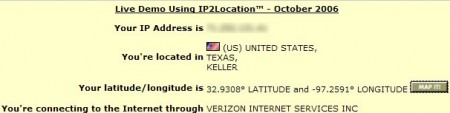
Image showing geolocation result

Of course it always seems like the porn industry is the first to take advantage of and drive new web technologies.  In a previous post I noted AT&T’s cheesy and annoying system for location verification with their CallVantage VoIP service.  Perhaps AT&T should consider hiring some people from the porn industry to make the process more painless.

Rubbish!

I may have occasionally griped about delayed garbage collection, but I do acknowledge that our scheme is a pretty good one when I compare it to some of other locations.

But the award for most complicated and unsanitary scheme probably goes to Cambridge, England, as noted by Paul Woods at the Adam Smith Institute.

My local city council’s explanation of its new refuse collection system is remarkably complicated. We have a black bin (or white bags), a black box, a green bin (or brown sacks) and a blue box involved. Not only are we expected to remember what type of rubbish goes in which bin or bag, but also which two sit on the street together and whether it’s week one for the first combination or week two.

Living in a house with three people easily creates more than three normal kitchen bin bags full of rubbish each week. Because of my council’s new system, this means that the day before collection, I’m looking at six bags of rubbish in my back yard, three of which have been there for more than a week. It’s unhygienic and it’s ugly. I’m fortunate enough to have a large back yard which holds the bags easily, but many people on my street do not. Their back yards will be fully occupied with bin bags the day before collection. And that’s without thinking of space in which to store bottles, paper and plastics.

I would hate to have to keep stuff for up to two weeks.  Not only is there a logistics problem of where to keep the stuff, it can be unsanitary and unsightly.  Will the town council reimburse them for their extra extermination and rodent-killing costs? 

I wonder why they had to make it so hard?  Or, conversely, how can Allied Waste handle collecting our garbage twice a week and separating our mixed recyclables for $8.91 per month?

Make It Stop!

Even as early as August I started to see a trickle in my mailbox.  A trickle that served as a distant early warning of things to come.  Yet I understood that with print catalogs that there’s a lot of lead time, and they’re fairly easy to ignore.

Today, however, we have a winner for the earliest jumping of the Christmas TV gun.  Specifically, those knuckleheads at Expedia nearly made me go all Elvis on my TV just now.  It’s too frakin’ early for “holiday” commercials and jingling bells.

What is it going to take to get a moratorium on Christmas commercials before Thanksgiving?  Who do I have to beat to a bloody pulp to make the madness stop?  (I’m looking at you, Expedia marketdroids).

Salute!

I frequently hear radio ads for an area steakhouse in the mornings, and they’ve been running one recently that makes me laugh and gives me a great mental image every time I hear it.

At the end of the commercial they make a statement about how their beef is the best in the country and that it’s “raised by proud American cows.” 

The last part doesn’t quite make sense but it’s a great mental image.

A Chainsaw Might Be The Best Option

Does anyone else out there hate those clear plastic packages with the heat-sealed rigid edges? 

They’re impossible to open without a knife or scissors and you have to be very careful to avoid scraping or stabbing yourself while opening.  A few companies seem to have gotten the message and put perforated panels on the back, but these seem to be in the minority.

I’ve observed that there are only really two strategies for opening these packages.  You can use your knife to cut around the edges or you can cut the edges off with scissors.  Each has its own particular perils.  If you use the knife, you have to be very careful not to slip and cut yourself, and the packaging often requires a good deal of force, so if you do slip you can cut yourself pretty badly (like I did to my thumb a couple of months ago, cutting both the thumb and scoring the nail quite badly; the nail has only recently grown back to a semi-normal state).  If you cut the edges off with scissors, you have to avoid stabbing yourself with the pointy end of the plastic shard that’s created from the outer edge of the seal. 

Really, I’m surprised that no one has been sued over these silly packages.  From a product liability standpoint, they seem like they’d be a losing proposition in these litigious times.

Hmm…  a new idea just occurred to me.  Clamp the package to a workbench and cut the perimeter with a Dremel.  At least that would (hopefully) avoid the need to put hands upon it until it’s completely open.  The only downside is that cutting plastic with a Dremel requires care to avoid burning/melting the plastic onto the cutting wheel.

Punishment, Rehabilitation, Trust

This morning’s arrest of Daniel Joseph Griffin got me to thinking about so-called “ex cons” and payment of a debt to society.

First, some details of this present case (from the first link):

34-year-old Daniel Joseph Griffin is believed to be with 19-year-old Christina Harrison. Witnesses tell police on Monday, he stabbed Harrison’s mother to death, tied up her sisters, then kidnapped Christina at gunpoint.

He is also said to have sexually assaulted one of the girls before taking off with Christina (his girlfriend).  According to the local news reports, he has a criminal history that includes theft, burglary and escape.

In the past I’ve written that I thought that once you’ve served your time you should be a full member of society again (of course, this presupposes that punishments are severe enough to fit the crime).  Theoretically, our system is supposed to be this way, but we all know that it isn’t.  There’s a stigma that follows these people around, often making it difficult for them to work and integrate back into society.  And then we have the case of the “sex offender,” who we brand for life and require to register so we can keep him under a microscope.

Cases like this one only serve to make me wonder if it’s hopelessly naive to think that we could ever trust or reintegrate some offenders back into society.  The problem is determining which ones should be considered an ongoing threat and never allowed out.  Griffin’s history doesn’t appear to have any crimes against persons, just property and financial crimes.  Still, common social stigma against consorting with ex-cons might have been very useful in this instance in keeping at least one person alive.  Is that unfair?  Probably so.  But on the other hand, it’s simply another factor to keep in mind when making the decision to break the law.  If someone has shown themselves as being unable to live in polite society once, it’s going to take a lot of good behavior afterward to regain any semblance of trust.

This also ties into recent proposals for the death penalty for child molesters.  I know some hand-wringing types get the vapors at the idea, but it doesn’t bother me.  It seems preferable to the strange legal limbo of registration.  That type of system seems to acknowledge that these people are dangerous, yet it still allows them out.  If someone is so dangerous that he has to be watched at all times, maybe he shouldn’t be allowed out in society again.  If not the death penalty, at least give them life in prison.

Oh well… there are no simple answers here.  Just bad situations.

Call It In

Here’s a case that shows why it’s a good idea to go ahead and call the Fire Department even if you think you’ve put out the fire:

Glen Robinson gazed at the smoldering remains of his home near Texas Christian University, glad to be alive, but fighting guilt.

His longtime landlord, William Tooley, died early Thursday in a fire that was sparked by a burning mattress.

“I’m ashamed to talk about it,” said Robinson, fighting back tears. “It’s my mattress. I guess that’s who you would blame.”

Robinson, who lived in a garage apartment, said his cigarette ignited the mattress around 1:30 a.m. Thursday. He doused the fire and then took the mattress outside, where he propped it against an outside wall.

“Unfortunately, he didn’t realize that those mattresses can smolder for some period of time,’’ said Lt. Kent Worley, a spokesman for the Fort Worth Fire Department.  “They’re tightly packed, like a cotton bale. “

“About four hours later, it did ignite the rear portion of the house, and that portion has been gutted by the flames.”

You can’t really be sure that a fire is out until you’ve torn out all of the burned area and gotten down to a clean, unburned, surface.  But rather than trying to make that determination yourself, it’d probably be best to let the FD come out and check.  It’s better to call it in and it turn out to be a false alarm than to think you’ve put out the fire only for it to return later.

Keller Go BOOM

Anyone in the area yesterday morning probably heard (or felt) the sonic boom that hit around 11:00 am.

Spend $45 million or so on an airplane, and you’d want to know if it can at least blow past Mach 1.

Well, most everyone in north Tarrant County can attest to one F-16’s readiness.

At least one F-16, flown by a Lockheed Martin test pilot, broke the sound barrier (a bit more than 750 mph) around 11 a.m. Wednesday, setting off a sonic boom that had people buzzing. Dozens of calls flooded police and fire dispatchers in Fort Worth, Keller and North Richland Hills.

Among the curious was the manager of a Sonic Drive-In in North Richland Hills. “Real weird,” Thomas Horne said about the boom.

Joe Stout, a Lockheed Martin spokesman, said two F-16s flying at over 30,000 feet were in a “supersonic corridor” that extends from Alliance Airport to Ardmore, Okla. Every plane is tested at supersonic speeds before anyone gets the keys.

“Occasionally the sound does carry into areas where we don’t want it to be heard,” Stout said. “We apologize to anybody inconvenienced.”

I used to hear them all the time when growing up in East Texas (I was told by someone that they were caused by SR-71’s going to Barksdale AFB, but I’ve never been able to confirm that), so I immediately thought “sonic boom” (and identified a second smaller one and that they came from the northwest).  However, it’d been a while since I’d heard one, and I don’t recall ever hearing one in Keller.  So I doubted myself for a second and went outside just to make sure there wasn’t a real explosion in the area.  But I didn’t see anything and just dismissed it.  However, on the scanner I heard dispatch call station 2 and mention that they were getting lots of calls for an explosion on the northwest side of town. 

I’m guessing that there must be a lot of people here who haven’t experienced many sonic booms, which is probably not surprising as the military tries to avoid supersonic overflights of highly populated areas.  Even in areas where they’re allowed to do it they tend to keep it confined to above 30,000 ft. (as in this case) to minimize the effects.

Once you’ve lived with them for a while they really aren’t too much bother, except for the fact that they scare the bejeebus out of the dog…

Smells Like Teen Spirit…

From the “tit-for-tat” department

Monty Snow at Keller City Limits has written about some interesting comments made by a council member and the mayor concerning the new fire station. 

In particular, consider the mayor’s comments (The Keller Citizen, Friday, October 6, 2006, Volume 27, No. 10, Page 7A—Not Available Online):

Mayor Julie Tandy agreed that more data should be presented on the need for the station.  “Citizens want to know what they’re getting for their money,” she said.  “It’s a longterm commitment.  At the end of the day, the building is a small part of it.”

She wondered if the project should be placed in the hands of the voters.  “As the community has evolved, they have a great interest in the buy-in,” she said.  “That’s another reason to get numbers.”

Smells a little like library payback to me.  Many of us who opposed the library thought it was a case of misplaced priorities and that items like the new fire station and frozen fire and police positions were more important at the time.  And I certainly still think that’s the case.  But where I find this particular cry of “send it to the voters” disingenuous is that it concerns a core city government function, rather than a peripheral item like the library.  Honestly, I find it odious that the mayor would attempt to hold an important public safety component hostage in an attempt to make a political point. 

But if it takes a vote to make her happy, then so be it.  Let’s get it going.  Put it on the ballot.  I don’t object to a vote.  In fact, I know that I’ve said that government in general shouldn’t be able to create large debts or obligations without public approval, so I’m willing to stand behind that.

Oh?  And even if this fire station causes a tax increase, I’m STILL likely to vote for it because, unlike art and libraries, it’s a CORE CITY FUNCTION. 

On a more serious note, though, I can’t help but think that the folks at Keller Fire-Rescue have done too good a job looking out for the citizens of Keller, to the point that certain factions find it convenient to forget their needs in doing that job.  Keller has negotiated mutual-aid compacts with surrounding cities so that response times have been maintained by calling on those cities when all Keller units are already working. 

Most people don’t think about Fire-Rescue’s resources because they just always seem to be there.  But consider that Keller, a city of approximately 36,328 residents, has only two fire stations.  There are two medic units (one at each station).  For fire apparatus, the city has a 100-ft ladder truck (T583, housed at station 3), a quint (at station 2), an engine (E582 at station 2), and one or two brush trucks (or so I recall, I’m working off of memory here).  All it takes is two major accidents, or a large fire to completely use up all of our resources, at which point we rely on Colleyville,  Southlake, or one of the other surrounding cities.  The same holds true for those cities—if they have a major incident Keller will respond, which means someone else (yet another city) has to backfill Keller if there’s an incident here.

I often listen to the Keller talkgroups on the Northeast Tarrant Public Service system on my scanner.  It’s interesting to hear the patterns that arise.  All it takes are the traditional Friday afternoon wrecks to tie up our Fire-Rescue folks (i.e. one major at 1709/Keller-Smithfield and another on 377 somewhere).  It’s interesting that they seem to come in around 4:00pm on Friday afternoon, usually within a few minutes of each other (although fortunately it hasn’t done so today… yet).

We’ve just been extraordinarily lucky that response times have been maintained so far.  If we reach the projected population of 40,127 by 2010 (one year after the new station is projected to be in service), we’ll just barely be keeping up with demand.

Compatibility, Standardization, and Cost

I’m about to do something not often done on this website.  I’m about to argue that KISD should spend more money than originally planned on something.  It’s not turf or stadiums, though.

One of the interesting things I learned last night when I took my CPR/AED renewal was that KISD is in the process of purchasing 55 AEDs for use on all of their campuses.  They are evaluating various models and comparing costs before making the purchase, which is of course the right thing to do.  In the absence of other factors, I’d suggest using cost to feature analysis and picking the one with the most features for the lowest cost. 

However, there are other factors to consider.  Specifically, the City of Keller has standardized on the LIFEPAK 500 AED from Medtronic.  While the LIFEPAK 500 isn’t the lowest cost model, it had the advantage of being directly compatible with the LIFEPAK 12 Defibrillator/Monitor that Keller Fire-Rescue carries on its trucks and medic units.  This means that the electrical pads that were applied to the patient for the AED can be plugged directly into the LIFEPAK 12 and the LIFEPAK 12 can use those pads for both defibrillation and pacing.  The 500 is also compatible with the Medtronic LIFEPAK defibrillator/monitors carried by the majority of EMS agencies in the KISD area (i.e. Medstar for Ft. Worth, Watagua DPS, Southlake Fire, etc). 

So why is this compatibility so important?  Can’t any AED save a life?  Certainly having an AED is better than not having one, so should KISD choose another one it’s not like their brand will cause people to die that wouldn’t have otherwise died (hopefully blank stare  ).  Still, though, there are some good reasons for compatibility:

  • As noted above, the electrode pads used by the LIFEPAK 500 are directly compatible with the LIFEPAK 12 and can be used for defibrillation and pacing as well as reading electrical activity (ECG) on the monitor.  Other brands would likely require removing the pads and replacing them with compatible ones.
  • Once a pad is used for defibrillation it will cause a burn (first degree) on the patient’s skin.  This is an acceptable side-effect, given that the alternative is dying.  However, it also means that if you have to change the pads you have to find a different position, which may require putting the new ones in a suboptimal location, as well as causing new burns.  The ideal locations are on the upper right chest and on the left side, towards the bottom of the ribcage, such that you’re making a diagonal through the heart.
  • When a pad is used the first time it breaks down some of the electrical resistance and will be more effective afterwards.  Replacing the pads means having to start over.
  • Changing pads takes additional time over just plugging the pads into the LIFEPAK 12.

While all AEDs are designed to be easy to use (per FDA/US Gov requirements), it should also be noted that Keller Fire-Rescue trains quite a few people in town on CPR and AEDs and the training is done with the 500T (the “inert” trainer for the 500; it simulates AED operation pretty realistically, but can’t actually shock anyone).  It certainly can’t hurt to have the same model of AED available that Keller Fire-Rescue trains with (although I do acknowledge that many KISD schools are outside Keller itself). 

This is one situation where I think spending a bit extra to insure compatibility and continuity of care is worth it.