Must. Sleep. Soon.

The installation of this one last component is not going well, since it’s giving a weird error that no one has seen before.  I’m sitting here listening to the deployment guy drone on about all the stuff he’s done, while my tech leads are trying to work things out.  I think part of the problem is that he did some weird stuff with symlinks that is causing all this grief, but I’m too damn tired to gripe at him about it.  If this goes on much longer I’m going to have to glue my eyelids open.

Unfortunately, I feel that dreary dead-tired nonsleepy state coming on (the one where it’s way past time to sleep and you enter that weird area where you can’t sleep anymore).

An Unfortunate Choice Of Words

Jeff Soyer at Alphecca points out a truly bad segue from a local news broadcast.  Having grown up in East Texas, I can attest to the inexperience of most of the news crews at these local stations.  If you really want to see raw inexperience in action, try watching the 6:00pm newscast on Saturday.

Major Geek Alert…

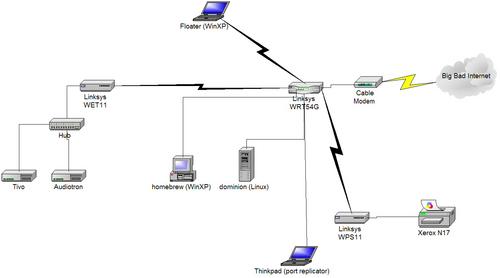
I’m sitting here waiting on the installation of our application, which means I have to be online, but I’m not really doing anything.  Earlier today, one of my coworkers asked me about my home network and I ended up drawing the diagram on the whiteboard in my office.  In the interests of killing time, I pulled up Visio and created a network diagram.


Click for obnoxiously large size.

What was the point of this post?  There is no point.  I’m bored and pointless…

Spread It Around

The whole issue of religion in school is one of those things that just makes me want to scream in frustration.  It’s like watching a car wreck as it happens, but in this case, both drivers are drunk.

The latest example to catch my attention concerns a case in Belle Fourche, S.D..

The mother of a Belle Fourche Middle School student has complained to the district after her son came home with a Bible that he said had been passed out in the school hallway.

“I was out of town. I came home, and it was sitting there in my house,” said Bonnie Matthews. “I questioned my son, and he said a man just handed it to him at school.”

When she contacted the school, an official said told her the Bible came from the Gideons International organization, which distributes Bibles throughout the world.

Matthews said the official told her school policy has allowed such distribution in the past, but that the school itself was not involved and did not sanction it.

Interestingly, the ACLU was OK with it.

Jennifer Ring, executive director of the American Civil Liberties Union in North Dakota and South Dakota, said distribution of religious materials in school is a form of free speech and religious freedom.

But it should only be done with clear conditions. School officials should not be involved, the school should not promote any religion, and there should not be restrictions on the types of religious beliefs expressed, she said.

“The ACLU is a big defender of religious freedom, as long as the regulation isn’t one that allows only one religion, as long as it’s open to everybody,” said Ring.

This caught my attention, because I was behind a pickup truck yesterday that had the phrase “ACLU is bound for hell” on the back bumper (and it wasn’t a bumper sticker, but instead was made from individual stick-on letters).  I know that the ACLU attracts a lot of detractors, but there are times when they’re a necessary evil.  I just wonder what they did to tick someone off so badly that they’d feel the need to make a sign on their vehicle.  I suspect it was something to do with prayer, given the message (and the other stickers on the truck).

My personal belief system is that I don’t believe, but I don’t necessarily disbelieve either.  I’m an agnostic (alternating between apathetic (‘I don’t care.’) and militant (‘I don’t know and you don’t either.’) ).  In any event, I will be up front and say that I have some antipathy towards organized religion of just about every stripe.  I distrust any organization that wants to control my life (and that includes government as well, so I’m an equal opportunity pain in the ass).  But over time I developed defense mechanisms (after once being “saved” as a naive youth by some evangelical door-to-door Baptist types, which East Texas is lousy with).  I’ve come to an uneasy truce with religion (or at least I don’t go into a frothing rage when people try this crap with me now). 

But regardless of my position on religion, I never minded when people gave me bibles.  Maybe that’s because I’m something of a bibliophile, and free books were cool (regardless of the subject).  Anyway, I think that both sides of this issue have a lot of crap to take the blame for.  The religionists bother me because they seem to think that just because a majority of the people (or so they claim) are on their side it makes it OK to have organized prayer in schools.  The anti-religionists bother me because they’re a bunch of whining crybabies who can’t be bothered to teach their children to resist programming.  This would have been a good chance for the woman in this article to teach her child how to evaluate ideas in the context of her own beliefs.

But ultimately this fight is unwinnable.  No one will ever be satisfied by the result, because they aren’t looking at the fundamental problem.  That problem, as I see it, is that public education has a fatal flaw.  What we’re seing in so many places (religion, sex education, testing, etc) is that the public school system cannot respond to market demand.  It must attempt to cater to all needs and all tastes (as well as all the additional crap that has been thrust upon it over the years).  What we’re seeing here is a frustration of market demand because of the government imposed monopoly in education.  If people’s demands are frustrated in the marketplace, eventually they will look for other routes to get them satisfied, by force if necessary (either the courts or the tyranny of the majority) if there are no other outlets.

If we’d get past the idea that education must be public, we can start to look at satisfying the needs of each stakeholder.  If some people want prayer and bible studies in their schools, that can be handled.  If others want ‘just the facts’, the market will provide for it.  But until then, we’re going to witness the various groups fighting over the public school agenda like a pack of crazed pit bulls over a hunk of meat.

Libertarianism And Intellectual Property

I just read an interesting posting at Samizdata.net concerning intellectual property and libertarianism.  The author goes over the basic types of intellectual property for the purpose of trying to make some observations about libertarian reaction to music file sharing.  I find myself torn on the subject of file sharing.  I think that rampant file sharing is theft, but at the same time I think that occasional sharing is actually good for the industry (for example, maybe I make a few files available to select friends of some artist that I found interesting in the hope that my friends would like them too; if I’m right, it’s possible that those friends will buy that artist’s music).  Is that an intellectually consistent position?  I don’t know.  And I don’t much care.  I want to see the artists get paid for their work, but there are probably other economic models that will come to pass after a while (which may see the big record labels go the way of the dinosaur).

But the mention of patents and software touched on one of my pet peeves.  I understand the reasons for patents, and I actually think some software patents are good (and I’ve even considered submitting for one through my company, although I haven’t had time to persue the process yet).  However, one of the first software patents that I learned about, and the most egregious example of the genre, was the one concerning the use of XOR for screen cursors.  In 1985, Autodesk was forced to pay $25,000 to license the XOR patent. 

To understand the absurdity of the patent, one must digress into computer geek land for a bit (or 8).  Bitwise XOR is an operation that can be used to “flip” all of the input bits so that the output is the “opposite” of the input.  XOR stands for eXclusive OR.  The easiest way to think of it is to remember the phrase, “one or the other but not both”.  Some examples:
     0 XOR 0 = 0
     0 XOR 1 = 1
     1 XOR 1 = 0
     10011001 XOR 11111111 = 01100110
     01100110 XOR 11111111 = 10011001

In the old DOS days, the cursor was simply the inverse of the character that the cursor was on (and each character was displayed in a single block on the screen).  Each character was composed of a set of pixels, with one bit representing one pixel (i.e black screen with green pixels).  If the bit representing the pixel was one, the pixel was on.  If it was zero, the pixel was off.

Since the bits represent the pixels, using XOR (with a mask of all ones) caused all the pixels that were off to come on and the pixels that were on to go off (see the last two examples above).  The simplicity of the operation was that it was the same operation to make the cursor blink on or off, and it was efficient, since the operation could be performed in hardware.

So why was this patent bad?  Because the operation was so simple it was something that any programmer would eventually come up with after a little thought.  In fact, it was almost a math exercise, which as noted in the Samizdata article could perhaps be thought of as a discovery, rather than an invention.

I think part of the problem is that the patent office doesn’t have the training in many cases to recognize the difference between a simple algorithmic technique and a truly novel and new idea.  The other thing that bothers me is how companies will suddenly “discover” that they had a patent on something important and try to blackmail the industry into paying for it (*cough* GIF *cough* Unisys *cough*).

Not Getting It

It looks like the administrators at The University of Arizona just don’t get it.

A UA graduation tradition has come under heat in recent years, but this year, President Pete Likins is serious when he says no tortillas at the ceremony.

Last year, Likins asked graduates not to throw tortillas. However, since many ignored the request, Likins sent out a formal letter to the class of 2003 stating reasons why tortilla flinging is inappropriate for the 128th commencement ceremony.

Both Likins and Provost George Davis have said tortilla throwing harbors undertones of racism, and can be offensive to not only some students, but to guests as well.

“More than being a safety issue, this behavior is disrespectful to many of our Hispanic and American Indian community members, who feel that throwing tortillas is offensive to their cultures,” Likins stated in the letter.

Offensive?  What do Hispanic people think about this?

Both e-mails have received criticism from students who believe that a ban on tortillas is also a ban on an innocent tradition that is not meant to send racist or violent signals.

Carlos Ramirez, a Hispanic graduating history student, called Likins’ e-mail “ridiculous.”

“It’s like saying you can’t throw sandwiches because they represent Caucasians,” he said. “You can’t throw Frisbees, so you throw tortillas because no one can get hurt.”

Members of Chicano/Hispano Student Affairs said they know that the tortillas are not tossed to offend, but rather, as a celebratory representation of the community.

Marisol Diaz, a CHSA retention specialist, said that although the tortillas might seem offensive to the administration, she has heard no complaints about it from any students, faculty or staff.

“They do it everywhere,” she said. “I have gone to a lot of high school graduations where they throw tortillas, and most of the people doing it were Hispanic.”

Like so much politically correct crapola, this oily concern for the feelings of others simply masks their real agenda, which is that they don’t want to be embarassed in front of the governor and a senator.

Likins said he also fears the tortilla throwing could get out control, causing someone, namely Gov. Janet Napolitano or Sen. Jon Kyl, who are both speaking at graduation, to be hit.

This sounds like it’s a long-standing tradition that is going to be hard to kill.  And the administration doesn’t have much traction on this one.  It just makes them look silly.  But these are probably people who piss into the wind and wonder why it’s raining when there are no clouds in the sky…

Rememberances

I find myself in a pensive mood today.  I’ve been thinking about my father lately.  Tomorrow will be the tenth anniversary of his passing, so I suppose it’s natural that he’d be on my mind.  My experience with my father is probably a bit different than that of others with their fathers.  He was 58 (my mother was 22) when I was born and he retired the summer between my first and second grade years.  I saw a lot more of him as I was growing up, especially during the summers, than those whose fathers were a lot younger.

My father was born on November 11, 1911 in East Texas to a family that made its living farming (mostly growing cotton). His father was an abusive alcoholic and a gambler, who lost the family farm in a card game. This forced them into sharecropping to survive, and my father and his brothers were put to work in the fields picking cotton at an early age. My father turned 18 in 1929, the year the Great Depression started. That was also the year that my grandfather chased my grandmother out of the house with a shotgun in a drunken rage. She took my father and his brothers to Ft. Worth, where they struggled to survive. My father managed to find a job as a bicycle messenger for Western Union to help support the family.

One of the things that I noticed as I was growing up was that his experience in the depression affected him for life. He was always concerned that we had enough to eat and that everything be fresh. I think this was because they had to make do with very little during that time. I recall one of his quirks was that he was obsessed with buying the freshest possible bread (this was a reaction to being forced to buy old, leftover bread since they couldn’t afford better). When I was growing up this was before they printed expiration dates on the bags of bread. But he somehow learned that they had color codes for the twist ties (which represented the day of the week it was made) and he also memorized the delivery schedules. I vividly remember being embarassed one day when he almost got into a fight with the bread delivery man because he was picking through the loaves looking for the ones with the newest color code (which were on the bottom, of course).

It was during that time in Ft. Worth that he managed to find work as an apprentice in heating and cooling. This would later become his career, and he would work his way up to the position of Chief Engineer by the time he retired (which means that he was responsible for the entire physical plant for a large building).

My mother was my father’s fourth marriage, and we were his second family. It’s strange to think that my father was 30 years old with a wife and baby when Pearl Harbor was bombed (I also have a half-sister who is in her 60’s now). He had vivid memories of that day, which I suspect that everyone who lived through that time had. At the time he was working in Washington, DC in one of the federal buildings. Because of his age and family status, he was deferred from being drafted. And because of the shortage of people caused by the war, he was hired by a chain of department stores to do maintenance throughout Texas (Dallas, Ft. Worth, San Antonio, Houston, etc) for the rest of the war.

One of his strongest qualities, though, was his work ethic. When he retired he definitely didn’t stop working. We left Houston and moved to East Texas and rented a house and 7 acres. He promptly bought a tractor and went to work, cultivating that land and growing corn, peas, sweet potatoes, watermelons, etc. I think he may have been trying to recapture something missing from his youth, but I also think that he didn’t know what to do with himself without work. When he wasn’t working in the fields, he was doing side jobs for people. He could do just about anything: plumbing, electrical work, carpentry, and of course heating/air/refrigeration. The downside, though, was that he would sometimes work too much, ignoring his health. He’d been diagnosed as a diabetic a couple of years before he retired. It was controllable through diet and medication, provided that he remembered to come in and eat and take the pills. Often he would go out in the morning and not come in until dark. Later, I think this habit caused the medication to stop, or perhaps it was just aging, be he was required to use insulin. This only made things worse, since he was still just as stubborn about not coming in until the last minute. One time his blood sugar level was around 40. We were surprised that he made it back in.

But some of my best memories of my father are when he would take me to work with him. From a very young age my father never talked down to me and he would answer my questions as best he could. He would also explain all of the equipment that he was working on, even though I was only five or six. I suspect that OSHA would have a cow today, thinking about a kid in the machine room of an office building. But my father trusted me and he knew that I wouldn’t touch anything. When we lived in Houston he worked for a property management company that handled a number of office buildings. He was one of their senior engineers so he was sometimes called to consult or in one case he was called in to set up the engineering department of a building that was just being finished. I remember being able to go up to the top floor of one of the Texaco buildings before it was finished (but the windows were in, so it wasn’t like we were just hanging off the side). I was amazed by the view. I also go to on the roof of another building he worked at. I think that it was this experience that allowed me to be comfortable working with technical information later on in life.

Unfortunately, I turned out to be just as stubborn and impatient as he was, which made for some rocky relations during my teen years. I don’t understand why I was so angry back then, it all seems silly now. When I left for college, we were somewhat strained, although not as bad as it had been. While I was in college his health started to decline (he was 77 when I started school). By my senior year in college, he was in really poor health, suffering from heart problems and diabetes. He also had what the doctors called ‘senile dementia’, which means that he would do or say strange and bizarre things for no apparent reason. But the biggest problem with diabetics at that age is that wounds don’t heal quickly, especially in the extremities. A stubbed toe becomes an infection, which leads to loss of the toe.

By the summer of 1992 the doctors were forced to amputate one of his legs due to an infection which was a complication of diabetes. And by the beginning of 1993 he lost his other leg for the same reason. During all of this I was finishing school and I started my first job, so I wasn’t around much, just on some weekends. I had a hard time seeing my father in that condition. I don’t know how my mother handled it, I just know that she’s amazingly strong to have cared for him as long as she did (with the help of my sister she cared for him at home until late in 1992).

My biggest regret is that by the time I could appreciate my father he was no longer himself. I wish now that I could have known him as an adult. I never got a chance to tell him that I loved him because he was gone too soon. And that’s a regret that’ll be with me for the rest of my life. For those of you who managed to read all of this, remember to tell your parents you love them. You never know if you’ll get the chance to do it later.

And So It Goes

Well, all that waiting around was for nothing.  The people who run the servers where our app is being installed didn’t do enough planning amongst themselves, causing the deployment to be delayed until Tuesday night.

I’ve now wasted the day for nothing.

Saturday Scruples

I’m still bored, I’ve read all the blogs in my blogroll, and everyone I wanted to call seems to be out (actually doing stuff as opposed to sitting around at home).  So, to pass the time I thought I’d do the Saturday Scruples.

  1. Your minister is forced to retire because he’s been convicted of committing rape 26 years ago. You’re invited to the retirement party. Do you go?

    Being an agnostic, I don’t have a minister.  And I would think if someone is being forced to retire because of previous misdeeds that there wouldn’t be a party (i.e. everything would be handled pretty quietly).  Besides, it seems in poor taste.  So, all things considered, if I were in that situation, I don’t think I would go.

  2. You’re a clerical worker. A new employee, a single mother, reads poorly and needs your help to do her job. Do you continue helping?

    That depends on how much it impacts my own job performance.  It’s unfortunate that she’s a single mother, but she was hired to do a job and was expected to have certain skills to succeed in that job.  I’d be inclined to give her plenty of chances to learn the job, but ultimately I can’t help her forever, since the employer expects me to do my own job.  I might try to give her information on local literacy programs so she could help herself.

  3. You hit it off with someone in a dark lounge and make a date. Before leaving, s/he asks for help getting into a wheelchair. Do you pursue the relationship?

    Yes.

Cool…

I noticed a little while ago that I passed 20,000 hits.  When I started this it was more or less just for me to vent about things that were pissing me off, and my audience was limited to just a few friends and family.  I’m pleased to see that people are taking time out of their day to visit my site and read my rantings.